Africa's Financial Leapfrog Has a Third Act, and it's On-Chain.
The temptation when reading a piece about African payments is to file it under "emerging markets" and move on. That thinking is five years out of date.
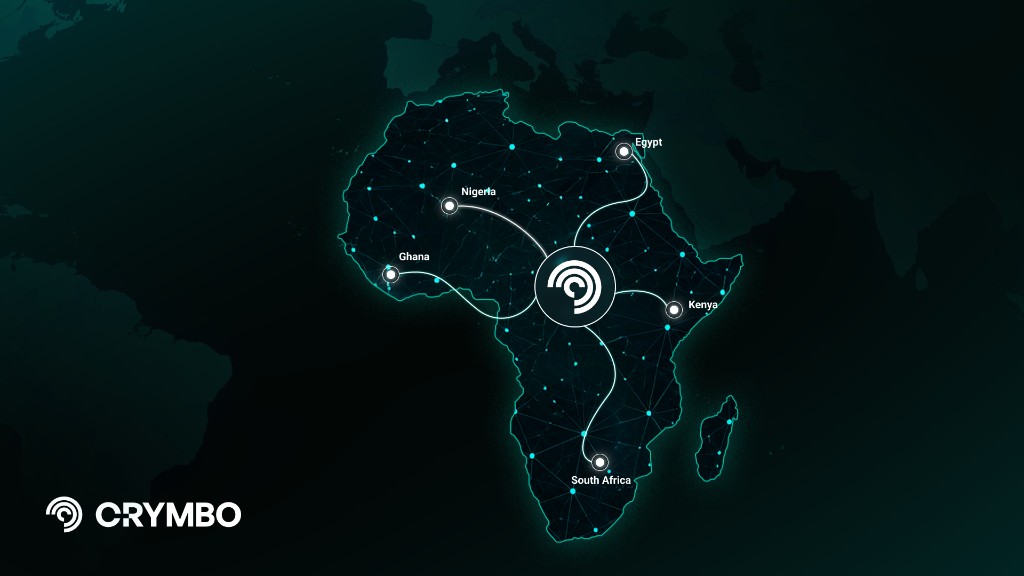
Africa skipped wired banking and went straight to mobile. Now the mobile money rails are settling on-chain in stablecoin. In early 2026 a continental payments operator went live across multiple Sub-Saharan markets, with one integration in place of an 18-month, $1M+ multi-vendor build, and their first live transaction within weeks.
That integration was CRYMBO's decentralized core financial infrastructure.
Africa is not emerging. It's leading.
Sub-Saharan Africa has ranked #1 on the Chainalysis Global Crypto Adoption Index every year since 2020. Nigeria sits inside the global top five by usage. Kenya, South Africa, Ghana, and Egypt all clear the threshold where digital assets are operational, not speculative.
African mobile money moves more than $900B annually (GSMA). Intra-African remittances cost 8.4% on average, the highest figure in the world (World Bank). Stablecoin rails compress that to single-digit basis points and clear in seconds.
The world's most expensive remittance corridors run between people who already use mobile money and already hold dollar stablecoins. The spread sits in the infrastructure that connects the two compliantly at the merchant layer.
How we got here, in three acts.
Act One. Cash to mobile money.
M-Pesa launched in Kenya in 2007. MTN MoMo, Airtel Money, Wave, and Onafriq followed. The continent skipped a generation of payments infrastructure. No correspondent banking installed base to defend, no card-network monopoly to disrupt, no legacy ACH to migrate from. The World Bank and IMF cite the result as the model for emerging-market financial inclusion.
Act Two. Mobile money to consumer fintech.
Flutterwave, Chipper Cash, Yellow Card, Luno, VALR, and Mara built consumer-facing apps that bridged mobile money, banks, and crypto exchanges. Local stablecoins emerged: cNGN in Nigeria, ZARP in South Africa. Every operator built its own institutional plumbing per market, separate custody, KYC, KYB, Travel Rule, sanctions, liquidity, fiat off-ramps. The consumer experience scaled. The infrastructure underneath did not.
Act Three. Infrastructure consolidates on-chain.
The mobile money rail settles in stablecoin under the hood. Compliance moves into the transaction layer itself. Identity travels alongside value at the protocol level. The end-user experience does not change. The merchant experience does not change. The institutional plumbing collapses from twelve vendors into one. This is the act now in motion. CRYMBO is the layer where it happens.
"Africa" doesn't ship as one product. It ships as five.
Bitmama, Bundle, Quidax, Bitnob, and their peers ship a different version per market because each market has a different regulator, mobile money rail, and KYC profile. Three markets means three regulatory regimes. The compliance matrix multiplies, it doesn't add.
Nigeria.
SEC Digital Asset Rules (2022). CBN reversed its crypto-bank restriction. Largest stablecoin corridor on the continent. cNGN lives as a regulated naira-backed stablecoin.
Kenya.
CMA finalising VASP guidance. M-Pesa is the dominant mobile money rail and the institutional integration target.
South Africa.
FSCA declared crypto a financial product in 2022. Most institutional regulatory regime on the continent. ZARP rand stablecoin live.
Ghana.
Licensing regime under construction. Cedi volatility makes Ghana a top retail use case for stablecoin savings.
Egypt.
Large MENA corridor. Regulatory framework evolving. Highest remittance demand, highest jurisdictional uncertainty.
A multi-vendor stack does not survive that complexity. Every vendor boundary is a regulatory exposure. See how CRYMBO stacks this in Security and on the Platform overview.
What CRYMBO shipped.
The operator's merchants now accept stablecoin and receive fiat to mobile money, or accept fiat and pay merchants in stablecoin, in the same checkout, across markets where the operator does not hold direct banking. Both directions, same ledger, same compliance enforcement. Most stablecoin payments products run one direction. This one runs both, the same way CRYMBO runs the cross-border on/off ramp as one flow for OTC desks and brokers.
The CRYMBO infrastructure.
- Pre-execution compliance: every transaction is checked against KYC, KYB, FATF Travel Rule (Recommendation 16, IVMS101), sanctions, and geo-blocking before it signs and broadcasts. Non-compliant transactions are blocked, not flagged after settlement.
- Oracle Identity Verification: cryptographic on-chain attestations. Client-held keys mean CRYMBO stores the encrypted blob and cannot read it. GDPR Article 25 by design. More in our FAQ.
- NodeMonitor: real-time on-chain monitoring, per-transaction risk scoring, immutable audit trail per regulator-jurisdiction.
- Multi-custody, cross-chain wallets: role-based access, white-label custody interfaces, policy enforcement at the protocol layer.
- Hybrid embedded integration: SSO or iframe drops crypto and stablecoin features into the merchant's existing dashboard. CRYMBO underneath. Operator's brand on top.
Adding a corridor, Lagos to Nairobi, Accra to Cairo, Cape Town to Lagos, is a configuration change. Not a new integration. Not a new vendor relationship. Not another compliance build. This is where the 8.4% remittance figure becomes a product.
This is for you…
If you run a fintech, VASP, or PSP in Africa and you have recognised your own roadmap in the multi-vendor build above, the consolidation conversation does not need to wait for the current build to finish. We have onboarded operators mid-build.
If you sit at a TradFi institution that has been pricing African expansion as a multi-year program, the unit economics on that pricing assumed the multi-vendor build. We just closed that assumption. The number on your last board deck is stale.
Are you an African operator, an institution entering Africa, a payments provider, or an RWA issuer scoping cross-border corridors? Either way, the next step is the same. Twenty minutes with our CEO. The calendar is open.
Eyal Daskal, CEO and Founder of CRYMBO, spent 15 years in banking and investment before founding CRYMBO, managing and trading hundreds of billions across structured products and financial services. That background made one structural problem impossible to ignore: licensed entities operating in crypto, EMIs, OTC desks, banks, stablecoin and RWA issuers, had no purpose-built infrastructure. They were running regulated, institutional-scale operations on systems designed for retail exchanges and consumer wallets. CRYMBO is the infrastructure layer built to fix that. Decentralized core banking for the on-chain economy. Identity and compliance embedded directly into transaction execution. Fiat and blockchain operating as a single system. Live and scaling, with active pipeline across banks, EMIs, OTC desks, payment companies, and RWA platforms across multiple jurisdictions.
Talk to us: Book 20 minutes with Eyal. See how Oracle Identity Verification works on the FAQ and Platform pages. Follow releases on News.
FAQs
- Can a payments operator launch compliant stablecoin merchant settlement across Africa without building 12-vendor infrastructure?
- Yes. CRYMBO consolidates custody, KYC and KYB, FATF Travel Rule, sanctions screening, liquidity routing, mobile money rails, and fiat off-ramps into one integration. A continental African payments operator went into production in weeks in Q1 2026.
- How does CRYMBO handle Nigeria, Kenya, South Africa, Ghana, and Egypt regulatory differences in one stack?
- Oracle Identity Verification carries jurisdiction-specific KYC and KYB attestations on-chain. Pre-execution compliance applies the right rule set per transaction based on merchant geography, counterparty geography, and transaction type.
- What is pre-execution compliance, and why does it matter in Africa?
- KYC, KYB, FATF Travel Rule (Recommendation 16, IVMS101), sanctions, and geo-blocking are applied before a transaction is signed and broadcast. Non-compliant transactions are blocked, not flagged after settlement. In African markets where regulatory regimes differ jurisdiction by jurisdiction, this prevents the failure mode of settling first and explaining later.
- Can merchants accept stablecoin and pay out in fiat on the same platform?
- Yes. Fiat-in / stablecoin-out and stablecoin-in / fiat-out, in the same checkout, on the same ledger. Settlement to mobile money wallets is supported in markets where direct fiat rails are unavailable.
- How long does a CRYMBO deployment take?
- The continental African operator referenced here moved from first call to production in weeks: demo access, hybrid integration design, commercial onboarding, production. The single-integration model is why this is weeks-to-months, not the 18 to 24 months a multi-vendor build typically takes.
- Does CRYMBO read or store sensitive identity data?
- No. Identity attestations are encrypted with client-held keys. CRYMBO stores the encrypted blob and cannot decrypt it. Only encrypted cryptographic attestations sit on-chain. Non-custodial encryption by design. Addresses GDPR Article 25.
- Who at CRYMBO does an operator or institution talk to?
- Eyal Daskal, CRYMBO's CEO and Founder, runs the first call personally. eyal@crymbo.com
Sources
- Chainalysis Geography of Cryptocurrency Reports, 2020 to 2024
- GSMA State of the Industry Report on Mobile Money
- World Bank Remittance Prices Worldwide
- Nigeria SEC Rules on Issuance, Offering Platforms and Custody of Digital Assets, 2022
- South Africa FSCA Declaration on Crypto Assets as Financial Product, 2022
- Kenya Capital Markets Authority VASP Guidance (in finalisation)
- CRYMBO Master Bible V7, March 2026 (capability and architecture)
- Eyal Daskal LinkedIn profile (bio source)