Crypto On/Off Ramps for Institutions: Why Cross-Border Fiat-to-Crypto Breaks, and How to Run It as One Flow
For OTC desks, brokers and banks, cross-border fiat-to-crypto is five disconnected systems: liquidity, banking rails, custody, identity and settlement. Here is why the on/off ramp breaks, and how CRYMBO runs it as one flow, one API, under your own license.
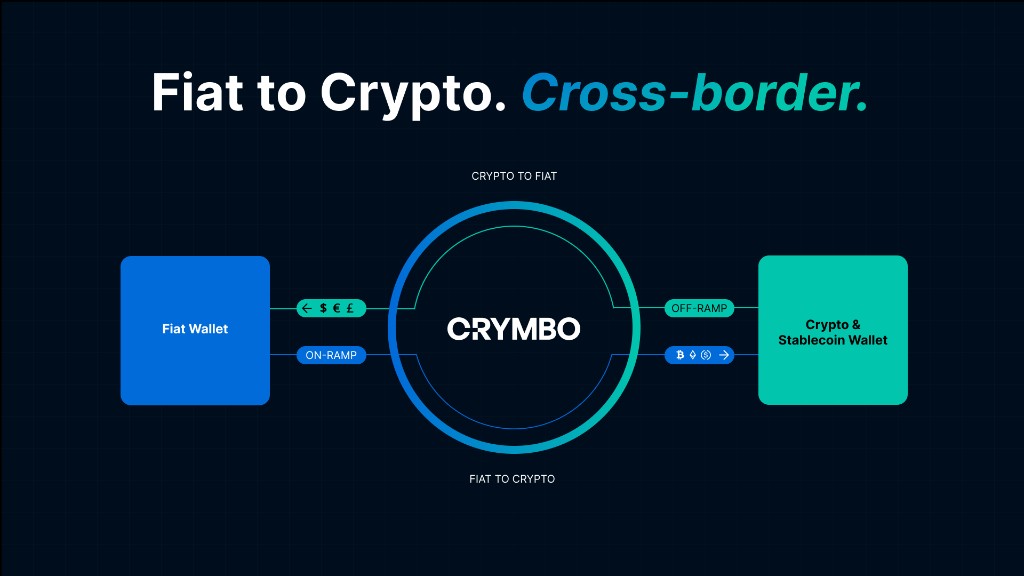
In one line: moving between fiat and crypto across borders is one of the most common things institutions run, and one of the hardest to operate, because it is really five systems that were never built to talk to each other. CRYMBO runs the whole on/off ramp as a single flow, on-ramp and off-ramp, fiat to crypto and back, across all chains, under your own brand and license.
Key takeaways
- A crypto on-ramp converts fiat into crypto or stablecoins; a crypto off-ramp converts crypto or stablecoins back into fiat. Cross-border, both directions, is the daily job for OTC desks, brokers, PSPs and banks.
- The on/off ramp breaks because it spans five separate systems: liquidity, banking rails, custody, identity, and settlement, each a different vendor on a different timeline.
- Wiring those together yourself is an integration project, not a product, and it sets a firm's risk posture for years.
- CRYMBO orchestrates 75+ providers inside one API, on one ledger, with compliance enforced before execution, white-label under your own license, live in weeks.
- Over $1.5B has moved through the platform this way, live with institutional clients worldwide.
Talk to a specialist · Download the guide: Buy, Don't Build
What is a crypto on/off ramp?
A crypto on/off ramp is the infrastructure that moves value between traditional money and digital assets. An on-ramp takes fiat currency and converts it into crypto or stablecoins. An off-ramp does the reverse, converting crypto or stablecoins back into fiat and settling it into a bank account. For a regulated institution, the ramp is not a single button. It is a chain of regulated steps: sourcing liquidity, moving fiat across banking rails, holding assets in custody, verifying identity, screening the transaction, and reconciling both legs once they settle.
Cross-border is where it gets harder. A conversion that crosses jurisdictions has to satisfy two sets of rules, move through correspondent banking with its own cut-off times, and reconcile a fiat leg and a crypto leg that settle in completely different systems and at completely different speeds. On-chain settlement can be seconds. The traditional cross-border leg can take days through correspondent banking.
Why the on/off ramp is where desks break
To an end client, a cross-border fiat-to-crypto conversion looks like a single line on a quote. Underneath, an OTC desk or broker is operating five systems that were never designed to work together:
- Liquidity. You need the right currency and the right asset in the right place at the right time, or the quote is dead on arrival.
- Banking rails. Fiat moves through banks and correspondents with their own cut-offs, holds and compliance checks.
- Custody. The digital asset has to move through a custodian or wallet infrastructure you trust and can audit.
- Identity and compliance. KYC, KYB, sanctions, Travel Rule and geo-rules must be satisfied before anything is signed, not after.
- Settlement and reconciliation. The two legs settle in separate systems, so someone has to reconcile them, usually by hand.
Settlement is where brokerages break, and cross-border is where the timing breaks hardest. Every one of those five systems is typically a different vendor, a different integration and a different point of failure. Volume cannot scale without operational headcount scaling with it.
The hidden cost: an integration project, not a product
The usual answer is to wire up a dozen specialist vendors, one for custody, one for compliance, one for identity, one for liquidity, one for settlement, and keep them in sync. That is an integration project, not a product. It typically costs a seven-figure budget and 12 to 24 months before a single transaction settles, and it never really ends: every new market, asset or product means another vendor and another integration. Worse, it locks in a firm's architecture, and therefore its risk posture, for the better part of a decade. This is the real build-versus-buy decision, and it is the subject of our guide, Buy, Don't Build.
How CRYMBO runs the on/off ramp as one flow
CRYMBO is decentralized core financial infrastructure for the on-chain economy. Instead of competing with the specialist providers a desk already knows, it orchestrates them inside one integration. Custody providers like Fireblocks, monitoring like Chainalysis, identity like Sumsub, and 75+ others are connected once and made to work together, under your own brand and license.
The whole on/off ramp runs as a single operation:
- One API and one platform replace the dozen-vendor integration project. On-ramp and off-ramp, fiat to crypto and back, across all chains.
- One unified ledger records both the fiat and crypto legs, so reconciliation is built in rather than done by hand.
- Compliance is enforced before execution. Identity, Travel Rule, sanctions and geo-rules are checked, and a non-compliant transaction is blocked before it is ever signed and broadcast. It is not caught and reversed after the fact; it cannot reach the chain in the first place.
- Any provider can be swapped with no client-facing change, because they sit behind an adapter layer, not hard-wired into your stack.
- White-label, under your own license. You stay the regulated entity; CRYMBO is the infrastructure underneath, launched under your brand and live in weeks, not years.
Underneath sit CRYMBO's seven proprietary engines, several patented: the Identity Oracle, NodeMonitor, Global Ledger, Auto Sweeping, Smart Routing, Flow Automation and the Quote Gateway. Institutions tell us these are the hard parts to build, and the parts they usually have to buy.
What this looks like in practice
- OTC desks, market makers and exchanges. Quote and settle cross-border fiat-to-crypto without stitching liquidity, custody, identity and settlement together by hand. Scale volume without scaling operational headcount, with a full on-chain audit trail.
- Brokers and multi-asset venues. Add crypto and stablecoin rails alongside existing products, reconciled on one ledger.
- PSPs and EMIs. Faster settlement and Travel Rule automated, with crypto rails that plug into what you already run.
- Banks and TradFi institutions. Move into digital assets without a rip-and-replace: add the stack on top of the systems you already operate.
Explore more use cases across desks, brokers, PSPs and banks.
Stablecoins, cross-border and the 2026 shift
The reason this matters now is that finance is moving on-chain. Stablecoins have become a serious settlement layer: more than $310 billion is in circulation as of July 2026 (source: DefiLlama), led by USDT and USDC. Regulation has caught up too. In Europe, MiCA has been fully applicable since 30 December 2024, and its transitional grandfathering window for existing crypto firms closed on 1 July 2026 (source: ESMA). Regulated institutions are following the volume. The open question is no longer whether to operate on-chain, but how to do it compliantly and at scale without absorbing years of build.
Build or buy? The honest framework
Building a digital-asset core in-house means hiring specialists, integrating and maintaining dozens of vendors, mapping compliance across jurisdictions, and carrying the regulatory risk of getting any of it wrong, all while the market moves. Buying CRYMBO means the integrations, the compliance and the seven engines are already in place, deployed under your brand and license, live in weeks. You keep control and the regulated relationship; you skip the year of undifferentiated build and the exposure that comes with it. Our guide walks through the real cost and timeline, and the 12 questions to ask any infrastructure provider before you sign. Download the guide: Buy, Don't Build
Proof
- Over $1.5B processed through the platform.
- 75+ integrated providers, orchestrated through one API.
- 350+ production-ready features across five capabilities.
- All chains, live on Ethereum, Solana, Polygon, Aptos, BNB Chain, XDC, Arbitrum, Base and Cardano.
- NodeMonitor caught $2.5M across two transactions a top-3 custodian's API missed.
- ISO 27001, MiCA-ready, built to FATF Recommendation 16 requirements, GDPR Article 25.
- Live with institutional clients worldwide.
Talk to a specialist
If your desk is weighing whether to build the on/off ramp in-house or buy it, we can walk you through how CRYMBO would run your exact flow, under your brand and license. Talk to a specialist.
FAQs
- What is the difference between a crypto on-ramp and an off-ramp?
- A crypto on-ramp converts fiat currency into crypto or stablecoins. A crypto off-ramp does the reverse, converting crypto or stablecoins back into fiat and settling it into a bank account. Institutions like OTC desks, brokers and banks run both directions, cross-border, every day.
- Why is cross-border fiat-to-crypto settlement so hard for institutions?
- Because it spans five separate systems that were never built to talk to each other: liquidity, banking rails, custody, identity and compliance, and settlement and reconciliation. Cross-border adds two sets of rules, correspondent-banking cut-offs, and a fiat leg and a crypto leg that settle in different systems at different speeds.
- Does CRYMBO compete with Fireblocks, Chainalysis or Sumsub?
- No. CRYMBO orchestrates them; it does not compete with them. You keep the specialist providers you already trust for custody, monitoring and identity. CRYMBO connects 75+ providers behind one API and one ledger, so they work together as a single flow instead of a dozen separate integrations.
- How does CRYMBO handle compliance on the ramp?
- Compliance is enforced before execution. Identity, Travel Rule, sanctions and geo-rules are checked, and a non-compliant transaction is blocked before it is ever signed and broadcast. It is not caught and reversed after the fact; it cannot reach the chain in the first place.
- Can we run this under our own brand and license?
- Yes. CRYMBO is white-label. You stay the regulated entity under your own license; CRYMBO is the infrastructure underneath, launched under your brand and live in weeks, not years.
- Which chains and assets are supported?
- All major chains, live on Ethereum, Solana, Polygon, Aptos, BNB Chain, XDC, Arbitrum, Base and Cardano, with support for major stablecoins including USDT and USDC.
- How long does it take to go live?
- Weeks, not years. Replacing a 12-to-24-month, dozen-vendor integration project with a single integration means institutions go live with CRYMBO in a matter of weeks.
Sources
- Stablecoin circulation figure, DefiLlama, July 2026
- MiCA application and transitional dates, ESMA
- CRYMBO platform figures are company-reported.