Technology adoption scales when it becomes accessible to everyone
The internet, blockchain and AI on one chart. Each scaled once services made it simple for businesses to build on and easy for ordinary people to use. CRYMBO is that layer for blockchain, under your brand, license and workflow.
Share of world population, by year since first mainstream availability
Year 1 is the point each technology first became available to the public. Dashed segments mark years with no published global estimate.
- Internet
- Blockchain
- AI
Share of world population
73.6%
Internet · year 33
9.3%
Blockchain · year 18
12.0%
AI · year 5
Years since launch
Sources: ITU World Telecommunication/ICT Indicators via Our World in Data and the World Bank; Cambridge Centre for Alternative Finance and Crypto.com Research; OpenAI. The three lines measure related but not identical things: internet use, crypto ownership and AI weekly activity.
In one line: blockchain is adopting far more slowly than the internet did, not because the technology is weak but because every institution still assembles its own infrastructure. Adoption curves bend the moment that work stops being yours, and CRYMBO is where that work stops.
Key takeaways
- Measured from year one, AI reached 12% of humanity in five years; the internet took eleven.
- Almost two decades in, blockchain reaches under a tenth of the world's population. At the same stage the internet was already well into mainstream use.
- Every technology on the chart scaled once services made it simple for businesses to build on and easy for ordinary people to use.
- A regulated institution today still integrates custody, screening, Travel Rule, banking rails and liquidity one by one: twelve to twenty-four months of work just to get a functional MVP.
- CRYMBO absorbs that work: one integration, 75+ providers, more than a dozen segments, under your own brand, license and workflow, live in weeks.
The chart puts the three technologies on one clock. Each curve starts from roughly the point the technology became available to the public rather than from the calendar year, so the shapes can be compared like for like. Read that way, three things stand out.
AI reached in five years what the internet took eleven to reach
Twelve percent of the world's population now uses ChatGPT every week. The internet did not cross that share of humanity until its eleventh year. On any reasonable measure, AI is the fastest adoption curve in recorded history, and ChatGPT is only one product. Google reported the Gemini app passing a billion monthly users in August 2026, so the real figure for AI as a whole is materially higher than the line on the chart.
Blockchain is running well behind the web's pace
Almost two decades in, blockchain reaches under a tenth of the world's population. The internet at the same stage was already well into mainstream use. Put differently, digital assets today sit roughly where the web sat in the early 2000s: proven, growing, and still years behind the pace of the technology everyone treats as the benchmark for fast adoption.
For its first nine years, nobody could even count it
There is no published global estimate of blockchain users before 2017. Not a disputed one, not a rough one, none. The first credible figure, from the Cambridge Centre for Alternative Finance, put active wallet users somewhere between 2.9 and 5.8 million, in a year when the internet had long since passed a billion people. There was nothing to count because there was almost nothing an ordinary institution could use.
The obvious explanation is the wrong one
The comfortable reading of this chart is that AI is genuinely useful, the internet was genuinely useful, and blockchain has spent eighteen years looking for a job. It is a tidy story and it does not survive the dates.
Consider what ChatGPT actually had to build in 2022. A model, and a text box. Everything underneath it already existed: broadband in most of the world, four billion smartphones, app stores that could distribute it, cloud infrastructure that could serve it, card networks that could charge for it, and a global population already accustomed to typing into a box and trusting the answer. Thirty years of other people's capital expenditure was sitting there, finished and paid for. AI did not have to build a single meter of road.
Now consider a business going online in 1995. It needed a leased line, its own server, someone on staff who could write HTML, and a way to take payment that did not yet exist: SSL shipped that year and PayPal was still three years away. Adoption moved at the speed of laying cable, because that is literally what it required. The web did not become slow-growing because the technology was weak. It grew at the speed its infrastructure allowed.
Technologies do not scale when they get better. They scale when someone else has already done the hard part.
The internet did not become an economy when TCP/IP became elegant. It became one when a shop could accept a card without building a payment network, when a company could publish without running a server, when a developer could ship without owning a data center. Stripe, AWS, Shopify, Cloudflare: the household names of the internet economy are mostly not internet inventions. They are the companies that absorbed the hard part so that everyone after them did not have to.
That layer is the least celebrated part of every adoption story and the single biggest determinant of its slope.
Every institution is still laying its own cable
This is the part that should be uncomfortable for our industry. A regulated institution that wants to offer digital-asset services today still has to solve custody, transaction monitoring, Travel Rule, banking rails, liquidity, licensing and reconciliation, and integrate every one of them itself, individually, before it can serve a single customer. Each provider has its own API, its own onboarding, its own compliance posture and its own failure modes. A bank does not get to buy the capability. It has to assemble it.
That is not a demand problem. Institutional demand is no longer the constraint: the regulation has arrived, the primitives work, the boards have approved the strategy. The constraint is that going live still takes twelve to twenty-four months of integration work followed by another year of internal approval, and most of that work is identical at every institution that does it.
It is the 1995 problem, thirty years later. Everyone is laying their own cable.
That cable already has a name in every other digital economy. Stripe, AWS and Shopify did not invent the internet; they absorbed the assembly so a business could go live without building a network. CRYMBO is that layer for regulated digital assets: one integration on top of the license, brand and workflow you already have.
What changes the slope
Adoption curves bend when the assembly work stops being the customer's problem. That is what the provider layer did for the web, and it is what has to exist before digital assets look like an economy rather than a technology.
CRYMBO is built as that layer, an orchestration layer on top of what you already run, and it is built around one principle that matters more than any feature: you keep what you have.
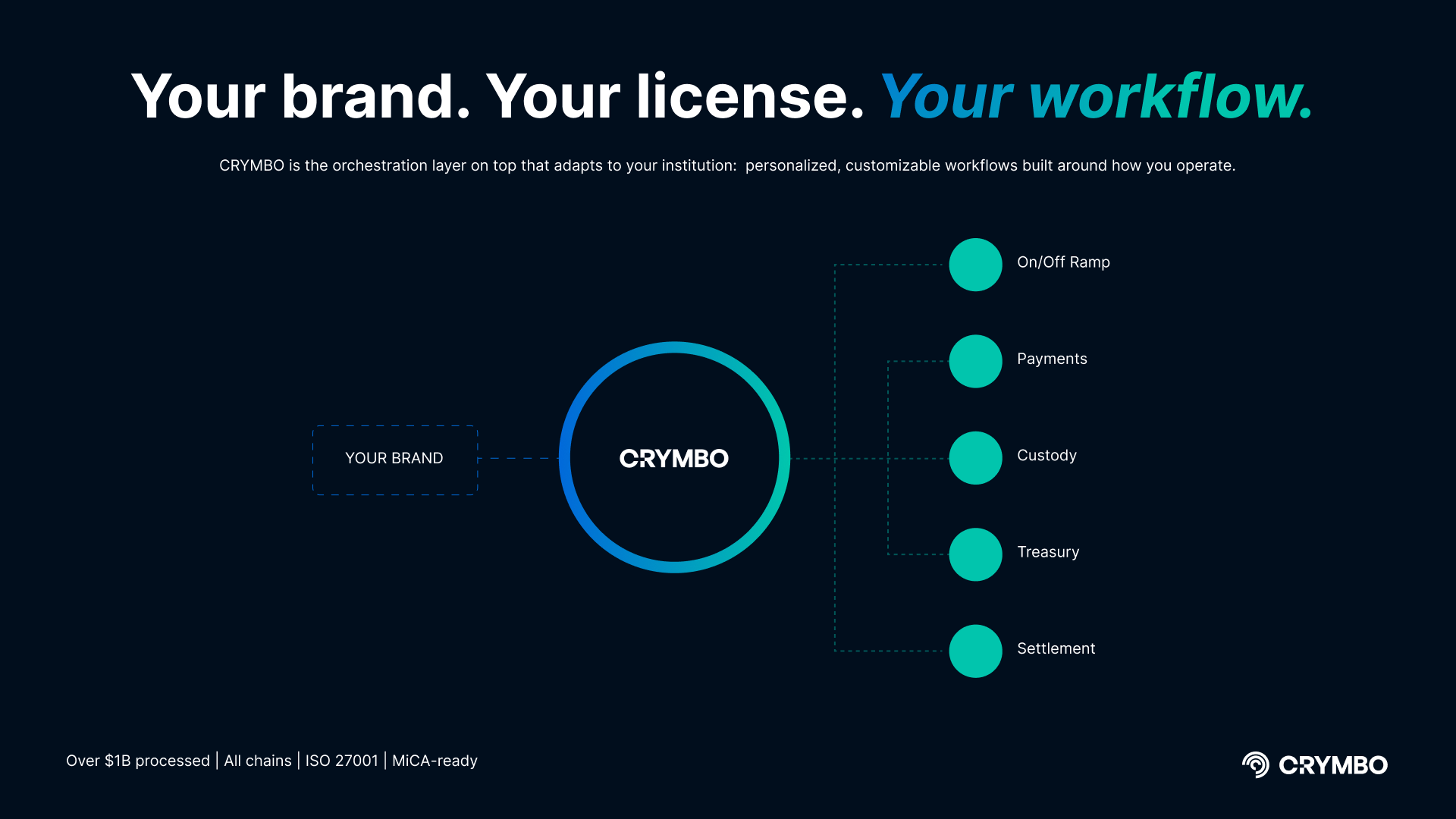
Your brand. Your license. Your workflow.
Your brand stays in front of the customer: the platform is white-label from day one, down to the dashboard your clients log into. Your license keeps doing its job: clients arrive with their own license and remain the regulated entity and the counterparty of record. And your workflow keeps working: the platform models your operation as it actually runs, onboarding, deposits, screening, conversion, settlement, payout, and orchestrates it across 75+ integrated providers through one integration. Personalized, configurable, changed as configuration rather than migration.
What that looks like in practice
A brokerage running a referral model moved to its own white-label platform this quarter: first conversation to agreed commercials in under a week, because the flow it needed, fiat in, conversion, fiat out, already existed on the platform and only had to be configured. A payments company preparing its launch walked its compliance team through the control model in one session: every wallet whitelisted before approval, every deposit risk-scored before it is credited, anything unknown held for review and never posted. And because every integration on the platform was built for a real customer, each new institution inherits all of them: the work is done once, and the next customer goes live in weeks instead of repeating it.
That is the difference between a technology and an economy. The chart above is not a story about crypto losing. It is a story about what has always been true: the technology arrives years before the economy does, and what closes the gap is infrastructure. The faster that layer is finished, the faster the curve turns.
Where is your institution on this curve?
Pick what you run and the flow you need. The blueprint updates as you choose.
What the institution keeps
Your license, your policy, your keys, your provider preferences and your brand. Clients arrive with their own license and remain the regulated entity and the counterparty of record. CRYMBO holds no financial license of its own, does not touch funds, and does not hold keys. CRYMBO also does not compete with any provider in the ecosystem, which is why provider choice stays a commercial decision for the institution rather than a lock-in.
Proof
- Over $1.5B processed through the platform.
- 75+ integrated providers across more than a dozen operational segments, orchestrated through one API.
- 350+ production-ready features, each one built from a real client requirement.
- ISO 27001 certified and built to the requirements of the frameworks our clients operate under: EU MiCA, Switzerland's FINMA, Hong Kong's HKMA and SFC, and Canada's FINTRAC.
Talk to a specialist
If the curve in this article describes your institution, the most useful next step is narrow. Pick the part of the flow that is furthest from going live, whether that is banking rails, custody, screening or reconciliation, and we will map what it takes to configure it rather than build it, what stays under your control and where responsibility sits on each side. Starting narrow does not constrain what follows, because the integration does not need rebuilding to extend it. Talk to a specialist.
Sources and method
- Internet: reconstructed from ITU and Our World in Data annual series for the share of individuals using the internet. The Our World in Data world series begins in 2005; figures before that year are reconstructed from continental totals. Year eleven, 2003, sits at approximately 12%; year eighteen, 2010, at 28.4%. The chart plots the internet through 2025, when ITU via Our World in Data puts world internet use at 73.6%. ITU has not yet published a 2026 internet-use share. Blockchain and AI are plotted through 2026, their latest published figures.
- Blockchain, first estimates: Cambridge Centre for Alternative Finance put active wallet users at 2.9 to 5.8 million in 2017, plotted here at the 4.35 million midpoint, then approximately 35 million in 2018 and 101 million in Q3 2020. There is no published global estimate before 2017.
- Blockchain, later series: Crypto.com Research, 306 million in 2021, 425 million in 2022, 580 million in 2023, 659 million in 2024, 741 million in 2025 and 774 million as of June 2026, which is 9.3% of world population in year eighteen.
- AI: OpenAI published counts for ChatGPT weekly users: 100 million at DevDay on 6 November 2023, 200 million in August 2024, 800 million at DevDay on 6 October 2025, and 1 billion weekly, reached in July 2026 and reported in August 2026, which is approximately 12% of world population in year five. Google separately reported the Gemini app passing 1 billion monthly users in August 2026, so total AI adoption is materially higher than the ChatGPT line shown.
- Population denominator: World Bank historical population, with UN projections of 8.23 billion for 2025 and 8.30 billion for 2026.
- Comparability: these three series do not measure the same act. Internet figures count people using the internet, blockchain figures count crypto ownership, and AI figures count weekly active use of one product. This is a comparison of the shape of three adoption curves against their own clocks, not a like-for-like measure of usage. The argument in this article rests on the slopes, not on the decimal places.
FAQs
- Why is blockchain adoption slower than the internet's was?
- Almost two decades in, blockchain reaches under a tenth of the world's population, while the internet at the same stage was already well into mainstream use. The gap is infrastructure: institutions still integrate custody, screening, banking rails and liquidity themselves, one provider at a time, so getting to a functional MVP takes twelve to twenty-four months of work that is repeated at every institution.
- Does CRYMBO replace our core banking or existing systems?
- No. CRYMBO replaces nothing. It is an orchestration layer that sits on top of the ledger, payment rails and vendors you already run, and coordinates digital-asset operations between them.
- Do we keep our own regulatory license and brand?
- Yes, both. The platform is white-label from day one, and clients arrive with their own license and remain the regulated entity and counterparty of record. CRYMBO holds no financial license of its own, does not touch funds and does not hold keys.
- How long does it take to go live?
- Deployment is measured in weeks rather than the twelve to twenty-four months an in-house build typically takes, because the integrations, the compliance layer and the engines already exist. Once your flow and providers are chosen, your environment is configured, not coded.
- How does compliance work on deposits?
- Whitelist-only access. Every wallet is screened before approval and every deposit is risk-scored before it is credited. Non-whitelisted transfers are held for review and never posted to your books.
- Which providers are available?
- 75+ integrated providers across more than a dozen operational segments, custody, liquidity, banking rails, payments, screening, identity and more, live on all major blockchains, every one built for a real customer and available through one integration. The full map is on the ecosystem page.